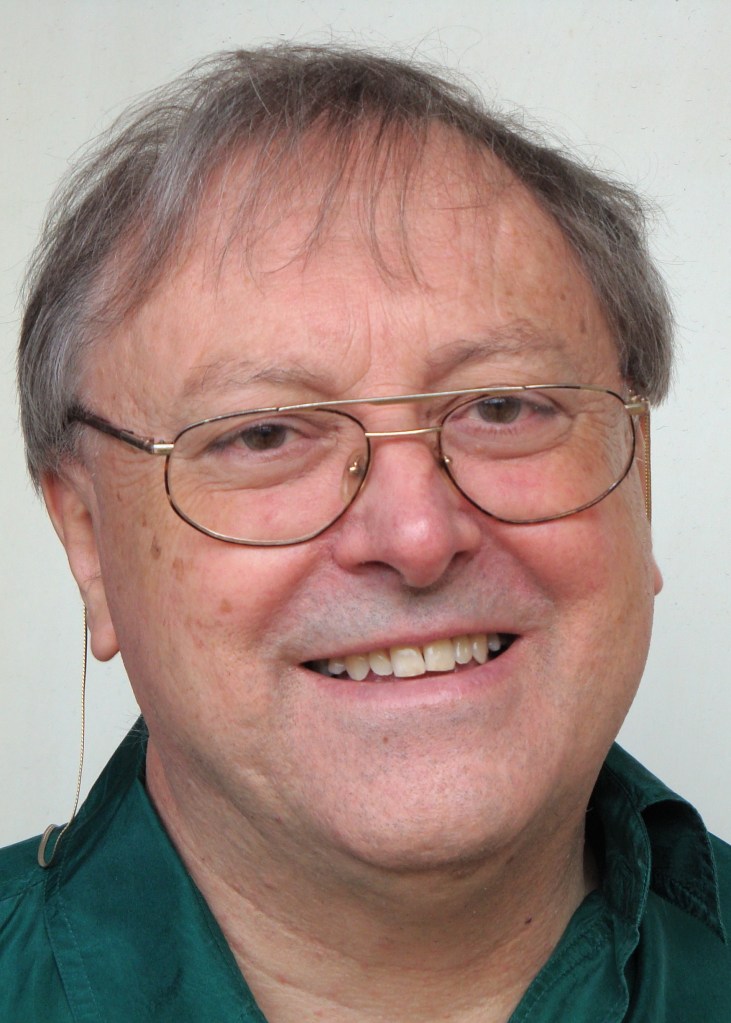
Gerry Huntman, Managing Director of IFWG Publishing International, interviews Richard Harland on his upcoming YA novel, Ferren and the Invaders of Heaven, last of his Ferren Trilogy.

G: Hi, Richard! Great to be able to sit and chat with one of our authors. Can we start by filling in a bit of your background?
R: Well, I lived the first twenty years of my life in England. Born in Yorkshire in the north, then over to Devon in the west, then London, then finally East Anglia and the town of Hadleigh. Hadleigh’s in what they call ‘Constable country’, the very pretty rural area painted by John Constable … thatched cottages, half-timbering, all of that. Looking back, I realise how fortunate I was. At the time, all I wanted was to get away to the big city lights!
I was about twenty-one when I migrated to Australia – an accidental migration because I never intended to stay. But after about six weeks of blue skies and sun and friendly, laid-back people, I knew this was the place for me! I started in Newcastle, NSW, then moved to Sydney, then the Blue Mountains, and I’ve finally ended up in the Illawarra, near Wollongong. A lot of wandering, but I found my true home in the end!
I guess it was the same with my writing career – which for twenty-five years wasn’t so much a career as a state of permanent writer’s block. After winning a prize for a literary story, I thought I wanted to write literary novels. It took me a long time to learn that my real groove was imagination and storytelling, then even longer to break the writer’s block. I bummed around as a muso and songwriter, a poet, a fringe academic – and eventually a serious, full-time academic. I published 3 books on language and literary theory, but still never stopped plugging away with the imaginative, storytelling side of my head. (I seem to be a split personality – very abstract and logical, or very visual and visceral!)
When that imaginative, storytelling side of my head actually gave birth to a whole, complete, finished novel – whooee! –I had the chance to become a full-time writer and I took the plunge, resigned my lectureship and committed to my original dream. I’ve been lucky since, nineteen fantasy novels published and international awards and success.
Funny how you can spend years and years going off track, and finally finish up where you wanted to be at the start!
G: You speak of your novels as fantasy – you feel you’ve found your true genre there?
R: Maybe I shouldn’t have said ‘fantasy’ – I meant it in a really broad sense. The Eddon and Vail novels would count as SF – but on the fantasy side of SF (science fantasy?). Worldshaker and its sequels would count as steampunk – but on the fantasy side of steampunk. The Vicar of Morbing Vyle and The Black Crusade would count as gothic horror – but again on the fantasy side. Probably my only books that would count as simple fantasy are my Wolf Kingdom quartet of novels for kids.
I like to use ‘fantasy’ in a broad sense because I like writing fantasies that push out and explore new worlds – new kinds of worlds. I’ll read and enjoy fantasies that keep to the old epic model – or other well-established models – as long as they’re not just formulaic, I can still love them. But it’s not what I want to write myself. I want the freedom of fantasy to imagine absolutely anything!
As with the world of the Ferren Trilogy, which IFWG is publishing. It’s not inspired by the usual Celtic or Norse mythologies, but by angelology – the esoteric lore concerning angels, fallen angels, Heaven and Hell, as preserved in not-quite-orthodox Christian/Judaic/Islamic texts such as the Apocrypha, the Kabala, Gnostic texts and the writings of the Sufi mystics. I call it fantasy, but it’s also SF, since it’s set in our world a thousand years from now, and the backstory begins when human medical scientists cross the boundary between life and death, resuscitate the brain of a subject who’s died and discover the reality of an afterlife with Heaven and angels. From that comes the endless war between the armies of Heaven and the armies of Earth that has reduced our continents to ruined wastelands – in that respect, a post-apocalyptic dystopia. Because this is a retro-future, the tremendous technology of the Humen who now rule the Earth is also a backwards, steampunk-like technology.
G: What about horror?
R: Definitely! There are elements of horror in the mix too. In Ferren and the Angel, it’s the shocking revelation of what the Humen really do to the original human beings they select for ‘military service’. In Ferren and the Doomsday Mission, it’s the kind of surgery that Doctor Saniette prepares to perform upon Miriael – and probably the nature of the giant Doctor himself. In Ferren and the Invaders of Heaven, I could point to various horrible deaths or Ferren’s near-death when he plunges into the cyberdog and feels himself suffocated by soft, woolly fibres creeping into his nose and blocking his airways…
I admit, I’m not into light, bright fantasy – I like dark, threatening worlds, where the beams of redemption shine out all the more wonderfully for the darkness. I think you appreciate the one because of the other.
G: What do you think of realistic fiction? It does nothing for you?
R: I suppose I was trying to write realist fiction when I was trying to write literary fiction – maybe I have a grudge against it for all my wasted years of writer’s block! Yet I loved the realist fiction I read when I was lecturing on Eng Lit – and I think I love a realist quality in all the fiction I read or watch, including crime, thriller, mystery. AND fantasy!
I’m working this out as I go along … I don’t enjoy fictions that seem to say, Oh, this is just make believe, we’re not taking ourselves too seriously, only having fun. I admire fantasy that takes itself very seriously – as Tolkien took his LOR world seriously, as Mervyn Peake took his Gormenghast seriously, as Richard Adams took his rabbit world seriously. Can you imagine any of those authors saying, Oh, it’s just a bit of fun, a bit of time out from the real world, I’m not so silly as to take it seriously. I think great fantasy writers are totally, insanely committed to the worlds they build. They immerse themselves completely in those worlds, and they expect the reader to do the same.
That’s part of the realist quality I look for in fantasy. And if you take your world so seriously, then of course you describe it seriously too, in full and convincing detail. An otherworld that isn’t the real world, but which exists with just as much solidity as the real one! You can see it, hear it, touch it, taste it! That’s my personal aspiration as a fantasy writer. I reckon it’s the ultimate challenge – to create in imagination a world far, far removed from the everyday one we live in, and then make it as real for experience as if we were living in it.
For example … This is a good example, because I fell down on this episode at first, it was just too much to imagine in detail so I found ways to skim over it. But in the end – well, it’s the all-important episode where Ferren, Miriael and their companions ascend to Heaven in order to take part in the fighting between the angels and the invading armies of Earth. They go up on a platform climbing endlessly upwards inside an openwork, metal tower constructed by the Humen. Hard to imagine, right? Definitely on the border of the imaginable! But that’s where the small, realistic details come in.
I thought of myself going up on the platform with Ferren and co. until I could see and hear and feel and smell what they would’ve done. The platform under their feet bearing them endlessly up into the sky, the wind blowing through the metal frame, the creaking of the struts, the hiss of cables running through the wheels. And the feeling inside – it would be like a train or plane journey carrying you inexorably towards your destination, everything as if suspended and waiting – waiting to arrive at a destination that’s both exciting and terrifying.I’ve slipped into something else there, but it’s important. An author can use all sorts of real, remembered details of experience in a fantasy, only a bit transposed and amplified. We all know that being-carried-inexorably-to-a-destination feeling from real world trains and planes. Or here’s another example from later in Ferren and the Invaders of Heaven, when Ferren and co. look back down to the Earth from the height of the sky, and see white clouds moving slowly, dreamily far, far below – and cloud-shadows moving over the ground even further below. I went back to the experience we all know of looking down on clouds from high up in a plane. If it’s real enough to me, I communicate the same reality to the reader – even though no one’s ever had the experience of looking through a hole opened up in the floor of Heaven by an angel sent crashing down to the Earth!

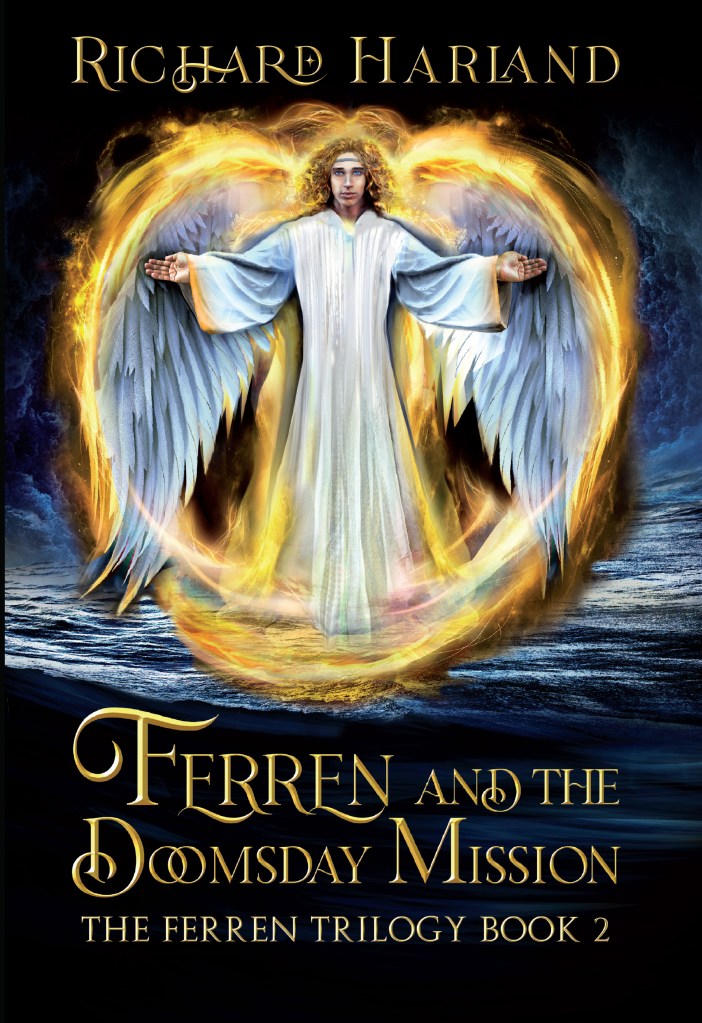
Ferren and the Invaders of Heaven will be globally released on the 26th February 2025, noting that stock will be delayed coming to Australia and New Zealand by about a month.
 IFWG Publishing